
Kim Lien Temple is a cultural symbol and a source of national pride when it comes to the ancient capital of Hanoi. Join BDATrip as we visit this meaningful destination that every visitor to Hanoi wishes to experience at least once.
Kim Lien Temple, also known as Kim Lien Shrine or Cao Son Temple, is one of the most prominent religious and historical landmarks in Hanoi. Positioned in the heart of Phuong Lien ward, Dong Da district, Hanoi, the temple holds a strategic and symbolic location. It was originally built in Dong Tac ward, Tho Xuong district, Hoai Duc prefecture, an area brimming with historical depth that echoes the significance of ancient temples in Vietnam.
This temple is renowned as one of Thang Long's Four Sacred Temples, which served as spiritual guardians of the cardinal directions of the citadel. Specifically, Kim Lien Temple protected the southern boundary, adding to its revered position among Hanoi's top religious sites. Visitors today can immerse themselves in its tranquil surroundings while reflecting on the many centuries of history encapsulated within its sacred grounds.
Moreover, its central location in modern-day Hanoi makes it easily accessible. Surrounded by bustling streets and nearby attractions, Kim Lien Temple stands as a serene oasis. Its proximity to other notable landmarks such as Quan Thanh Temple in Hanoi, Hoan Kiem Lake, and the Imperial Citadel of Thang Long makes it an essential stop for tourists seeking to explore the cultural fabric of the city.
The story of Kim Lien Temple in Vietnam is steeped in legend and spirituality. It is said to be a tribute to Cao Son Dai Vuong, a mythical figure deeply revered in Vietnamese folklore. According to historical accounts, in the early 16th century, King Le Tuong Duc encountered an ancient shrine dedicated to Cao Son while traveling through Phung Hoa district in modern-day Ninh Binh province. The king, facing an intense rebellion, prayed at the shrine for divine assistance.
Miraculously, within 10 days, the rebellion was quelled, and the kingdom restored. In gratitude, the king vowed to honor Cao Son by constructing a temple. The first temple was built in Phung Hoa, but its relocation to Hanoi's Kim Hoa ward ensured that it was closer to the royal citadel of Thang Long. Over time, this site became one of the most important temples in Hanoi, recognized for its spiritual significance and its deep connection to the city's cultural identity.

Adding to its mystique, Kim Lien Temple is also associated with the worship of other figures, including the Mother Goddess and President Ho Chi Minh, showcasing a unique blend of ancient and modern beliefs. This combination of traditions makes it a fascinating site for anyone exploring Hanoi's sacred temples.
Kim Lien Temple stands out among Hanoi's historical temples for its intricate architecture and exceptional feng shui positioning. Built on a high mound near Kim Lien Pond, the temple’s design harmonizes with its natural surroundings, reflecting the traditional Vietnamese principle of “mountain at the back, water in front.”
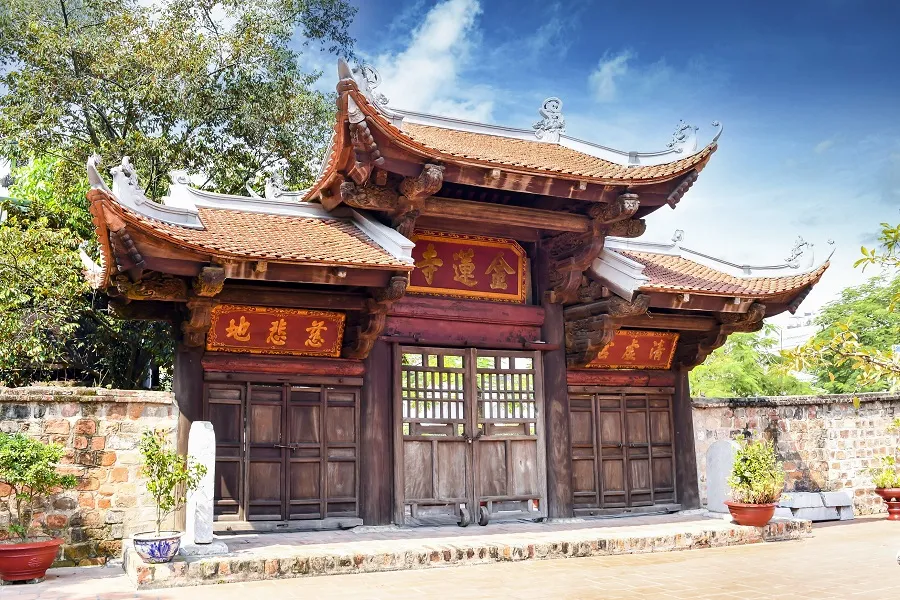
Visitors are greeted by the Nghi Mon (Gate), a three-room structure crafted during the Nguyen dynasty. This entryway is adorned with ornate carvings that showcase the artistry of ancient Vietnamese craftsmen. Beyond the gate lies the Dai Bai (Great Hall), a spacious five-room structure restored to maintain its historical essence. This hall serves as the focal point for major rituals and ceremonies.

Ascending the nine brick steps, which date back to the Le Trung Hung period, visitors reach the Cung Cam (Sanctuary). This sacred space, constructed with traditional materials and techniques, houses the altar of Cao Son Dai Vuong. The sanctuary is also home to altars for Princess Hue Minh and other historical figures, making it a site of deep spiritual resonance.
The overall design of Kim Lien Temple reflects the evolution of Vietnamese temple architecture, seamlessly blending functionality with artistic expression. The use of traditional tiles, wooden beams, and carved motifs preserves the temple’s timeless appeal, making it a treasure trove for architecture enthusiasts.
One of the most historically significant features of Kim Lien Temple in Hanoi is its ancient stone stele, "Cao Son Dai Vuong Than Tu Bi Minh." Created in 1510 by Le Tung, a renowned scholar of the Le dynasty, the stele serves as both a historical document and a work of art. It details the life and contributions of Cao Son Dai Vuong, particularly his role in aiding King Le Tuong Duc during a tumultuous period in Vietnamese history.

The stele is more than just a historical record; it is a testament to the temple’s enduring importance. Despite the passage of centuries, this artifact has been meticulously preserved, allowing visitors to connect with Vietnam’s rich cultural heritage. The stone inscriptions also offer insights into the beliefs and values of the time, providing a window into the spiritual life of ancient Thang Long.
In addition to the stele, Kim Lien Temple houses 39 royal decrees issued by various kings. These decrees not only affirm the deity’s significance but also highlight the temple's pivotal role in the spiritual and cultural life of the city. These artifacts make Kim Lien Temple a must-visit for history enthusiasts and researchers.
The Kim Lien Temple Festival, held annually on the 15th and 16th days of the 3rd lunar month, is one of Hanoi’s most vibrant cultural events. This festival not only honors Cao Son Dai Vuong but also celebrates the rich traditions of the Kim Lien community.
The festivities begin with solemn rituals at the temple, where villagers gather to offer incense and prayers. The highlight of the festival is the grand procession featuring four ornate palanquins: the Long Dinh, the male palanquin, the female palanquin, and the hammock palanquin. This procession, which moves through the streets of Kim Hoa and Dao Duy Anh, is a spectacular display of color, music, and devotion.

Other notable events include the unique hair-cutting contest, where barbers showcase their skills in an artistic and entertaining manner, and traditional games like bird fighting, wrestling, and duck catching in the pond. The day concludes with music and dance performances, creating a festive atmosphere that brings the community together.
For visitors, attending the Kim Lien Temple Festival is an unforgettable experience that offers a glimpse into Hanoi’s rich cultural tapestry.
Kim Lien Temple is not only a place of great cultural value but also a sacred site that many believe fulfills prayers and wishes. A visit to Kim Lien Temple allows you to admire its ancient beauty while offering a chance to express hopes for a prosperous life for yourself and your loved ones.
Some tourist destinations in Hanoi:


